
In short: Cost price is what you actually pay to get an item onto your shelf, including the purchase price and any costs tied directly to it.
The full guide: Pricing your products
Work it out now: Profit margin
Cost price is the amount you actually paid for one unit of an item by the time it is ready to sell. It starts with the supplier's price and adds any cost tied directly to that item, such as delivery or handling. Unit cost = (purchase price + direct costs) ÷ number of units. Without a correct cost price, you cannot know your real profit on any item, or set a selling price with confidence.
A Jordanian grocery usually buys by the carton and sells by the piece, so the carton cost has to become a unit cost. In Ghalleh you type the cost when you receive stock, or photograph the supplier's invoice and Ghalleh reads its lines, and profit is worked out from that cost: sales minus cost. You see what you actually earned, not just what you sold.
What goes into cost price and what does not
| Part of the item's cost | Not part of it; counted in net profit |
|---|---|
| Purchase price after the supplier's discount | Rent and salaries |
| Delivery and handling of the goods | Electricity, water and internet |
| Purchase tax, if you cannot deduct it | Card fees and maintenance |
Why cost price changes
If the supplier raises prices and you do not update the cost, your system will show profit that does not exist. Remember supplier discounts and free goods too, because they lower the unit cost. And keep item costs separate from general shop expenses, because mixing them distorts both your prices and your profit.
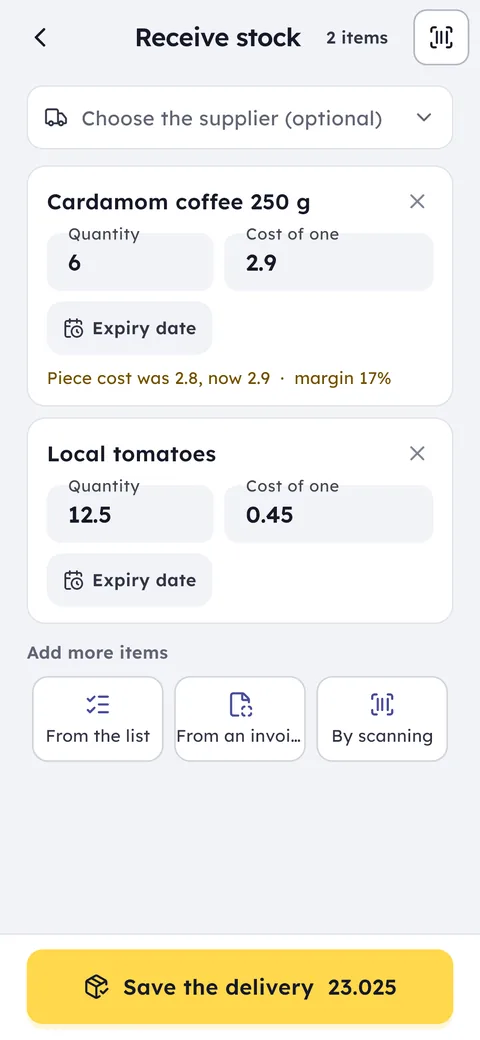
A shop example
A grocery in Jabal Amman buys a 24-can carton of soft drinks for JOD 7.200 and pays JOD 0.480 delivery on it. The full cost is JOD 7.680, so each can costs 7.680 ÷ 24 = JOD 0.320, not the JOD 0.300 the invoice alone suggests.
Common questions
Does sales tax go into cost price?
If your shop is registered for sales tax and deducts the tax on purchases, cost is usually recorded without the tax. If you cannot deduct it, it is part of the cost. Check your own case with your accountant.
What if I bought the same item at different prices?
A common approach is weighted average cost: add up the value of old and new stock, then divide by the total quantity to get one unit cost.