
Features
A digital debt book for your shop, instead of the paper one
Your debt book, in your pocket and never lost: every debt sits on its invoice, with a due date and partial payments, and statements reach the customer on WhatsApp.
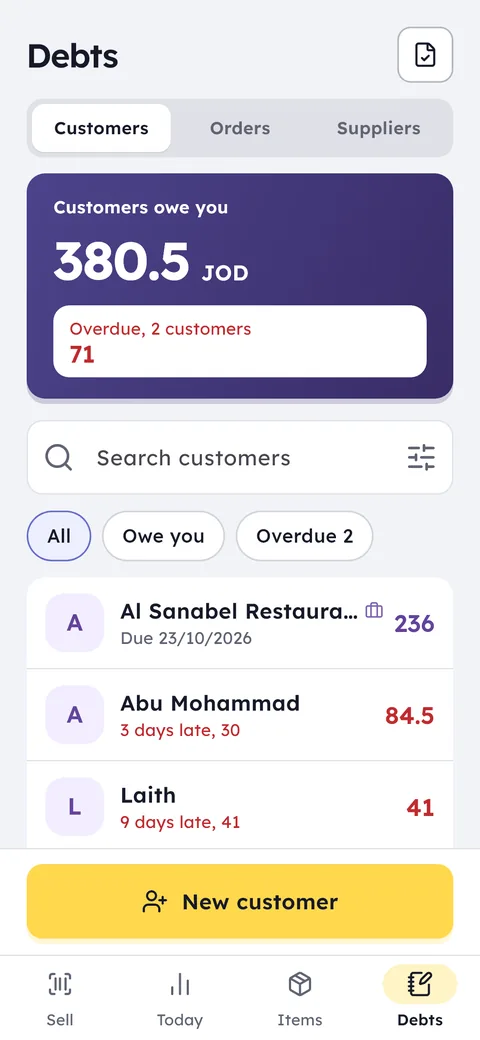
What this feature does: Debts and receivables
One account per customer
What they owe, what they paid, and when the rest is due, on their own page.
Partial payments
Record what the customer pays in stages, and the balance updates with each payment.
Statements and reminders
Send a PDF statement or a reminder of what is due to the customer's WhatsApp from inside the app.
Installment plans
Split an amount into payments on set dates, with a down payment and a guarantor if you want.
Payment vouchers
Each time a customer pays toward their account, a payment voucher shows the amount and the balance left, printed or shared.
Trade prices
A second price on each item for trade accounts: contractors, garages, schools and shops. Pick the account on the invoice and its price applies on its own.
A limit per customer
Set a credit limit on the customer, and selling to them on credit stops once they reach it.
Loyalty points
Customers earn points with every dinar and spend them on a sale when they like.
Choose debt as the payment at checkout, for all or part of it, and set a due date.
Each payment the customer brings is recorded on their account, in cash or any other method, with a payment voucher.
Send a statement or reminder on WhatsApp when a payment date gets close.
Debts on loose paper are one of the biggest leaks in a shop's profit: a slip goes missing, an amount is forgotten, a customer says they already paid. In Ghalleh every debt is recorded with the sale itself, on the customer's account, with a clear due date. When they pay part, log it and the balance updates. Total unpaid debts across all customers are always one screen away.
Collecting is easier when the number is on record. Send the customer their statement on WhatsApp and they see every invoice and payment with its date, with no awkward conversation at the counter. For mobile phone and electronics shops, installment plans split an amount into monthly payments on set dates. And loyalty points give your regulars one more reason to come back.
- A regular asks for creditYou record it on the invoice itself, so there is no slip to lose and no number to keep in your head.
- A dispute over what is owedOpen their statement and send it: every invoice and payment with its date, and the conversation stays calm.
- A phone on six-month installmentsSet the payments and their dates once, and see every month who has paid and who is late.
- A contractor pays part of his tabLog the payment and a voucher comes out with the amount and the balance left, printed for him or sent to his phone.
What the paper notebook costs you
- You do not know the total people owe you, which may be enough to buy a full month of stock.
- Every customer who asks how much they owe waits while you flip pages and add up.
- Partial payments get scribbled in the margin, so what was paid and what is left blur together.
- Staff record debts their own way, or not at all.
- Disputes over an amount never get settled, because the page does not show what was bought and when.
- If the notebook is lost or gets wet, the debts go with it.
Rules before the book
A digital book organises credit, but it does not decide who gets it. Set your own rules: who can buy on credit, the limit for each customer, and when they pay, for example at the start of the month with their salary. Tell customers the rule from the start. Clarity protects the relationship better than politeness does.
In Ghalleh the rule lives in the app too. A credit limit on the customer stops new credit once they reach it, and selling on credit is a permission you give to some staff and not others. Every debt is recorded under the employee who entered it, so there is no credit without a name and no sale lost because someone said they will pay later.
Collecting without losing the customer
- Send a statement, not a demand: a PDF showing what they bought, what they paid and what is left, with no reproach.
- Pick your moment: the start of the month, after salaries, works better than the middle.
- Remind politely and occasionally, not every day. The Remind button sends only the amount due on WhatsApp.
- Offer instalments: a customer owing 60 JOD may manage 15 JOD a week for four weeks but not the full amount at once.
- Never chase a debt in front of other customers.
- When a customer reaches their limit, new credit stops on its own until they pay some back, so you do not have to say it at the counter.
Installments and guarantors
Some shops, like mobile phone and appliance stores, sell on installments. At payment choose Debt, then Installments, type the down payment and the number of installments, and Ghalleh works out each payment and its date. For example: a phone at 240 JOD, 60 JOD down, and the remaining 180 JOD over 6 monthly installments of 30 JOD.
The customer's details have a guarantor field for installments: a name and a mobile number only, no documents. Each month you see who has paid and who is late, and you can get an alert for late payments. Ask your accountant how installment sales should be recorded in your books.
Trade accounts and cheques
For contractors, garages, schools and shops that buy from you in bulk, turn on Trade account in the customer's details and set the company tax number, payment terms and credit limit. Their sales are priced at trade prices, and their JoFotara invoice carries the company name and tax number.
Companies often pay by cheque. Record the cheque with its number and due date and it shows under Cheques in Debts, while reports list the cheques due within 3 days before the date slips past.
Cash or receivable invoice on JoFotara
Once your shop is connected to JoFotara, you never pick the invoice type by hand. A cash sale goes as a cash invoice, a sale on credit (in full or in part) as a receivable invoice, and Ghalleh chooses from the payment method you used at the till. When the customer settles later, they get a payment voucher from Ghalleh, and no second invoice is issued for the same goods.
Loyalty points for your customers
A customer who buys from you every day deserves a reason to stay. From the shop menu open Points programme and turn it on, then set how many points a customer earns per dinar and what a point is worth when spent.
At payment you add the customer by mobile number and their points are recorded, and when they want to spend them you tap Spend from their points and the amount comes off the sale. You can also sell gift vouchers with an 8-character code, redeemed later at payment. Reports show new members of the points programme.
Credit affects profit and cash
An unpaid debt is not profit in your pocket. The goods have left your shelf and their price is still with the customer. A shop that sells well but whose debts grow every month can find itself with no cash for next week's stock.
So Ghalleh's reports show debts by age: up to 30 days, 31 to 60 days, and over 60 days, with the number of customers who owe payments. Watch that figure the way you watch sales, and if it climbs month after month, tighten the rules before it becomes your biggest problem.
Common questions
What is a digital debt book?
A digital record of customer debts instead of a paper notebook: a page for each customer, every debt linked to its invoice, partial payments and the balance left, and the total owed across all customers.
Will I know when an employee records a debt?
Yes, if you want to. Turn on debt notifications and your phone alerts you every time a new debt is recorded in the shop.
Can a debt be paid in parts?
Yes. Record each payment as it comes in, and the customer's account shows what is paid, what is left and the due date.
How do I send a statement to a customer?
From the customer's page, send a PDF statement with every movement, or a reminder of the amount due, on WhatsApp.
How do I remind a customer politely?
Send their statement with what they bought, what they paid and what is left, at a good moment such as the start of the month, with no reproach and never in front of others. Offer small payments if the amount is large.
Can I set a limit for each customer's debt?
Yes. Type a credit limit in the customer's details, and no new sale on credit goes through once they reach it.
Can I give customers proof that they paid?
Yes. Every payment on a customer's account produces a payment voucher with the amount paid and the balance left, printed or shared. And on a sale on account, the receipt itself prints their balance after the sale.
Can I set special prices for contractors and shops?
Yes. Give each item a second trade price and mark the customer as a trade account. When you pick them on the invoice the trade prices apply automatically, and the invoice goes to JoFotara with their name and company tax number.
Does Ghalleh have loyalty points?
Yes. Turn on the points programme from the shop menu, set what a customer earns per dinar and what a point is worth, and they spend their points on a sale whenever they like.
Open your shop on Ghalleh today.
Download the app, set up your shop yourself and try every feature free for 14 days, with no card.