

The supermarket guide
Supermarket POS in Jordan: thousands of items, no typing
A mid-sized supermarket in Amman, Zarqa or Irbid carries thousands of items, and typing them in one by one takes weeks. In Ghalleh you start from an Excel file: a column each for name, barcode, cost, selling price, category and quantity. If you have an old system, export its list, arrange it in those columns and import it once.
Ghalleh reads xlsx, xls and csv files of up to 20,000 rows, matches the columns itself, and shows you the rows to review before it saves. After importing, scan twenty random items off the shelves and check the price before your first day of selling.
- Import on a quiet day, not at the start of the month when payday crowds arrive
- Tidy category names first: dairy is dairy, not dairy in one file and milk in another
- Keep a copy of the imported file as a reference for your first stocktake
About 388 ready items with their brand logos
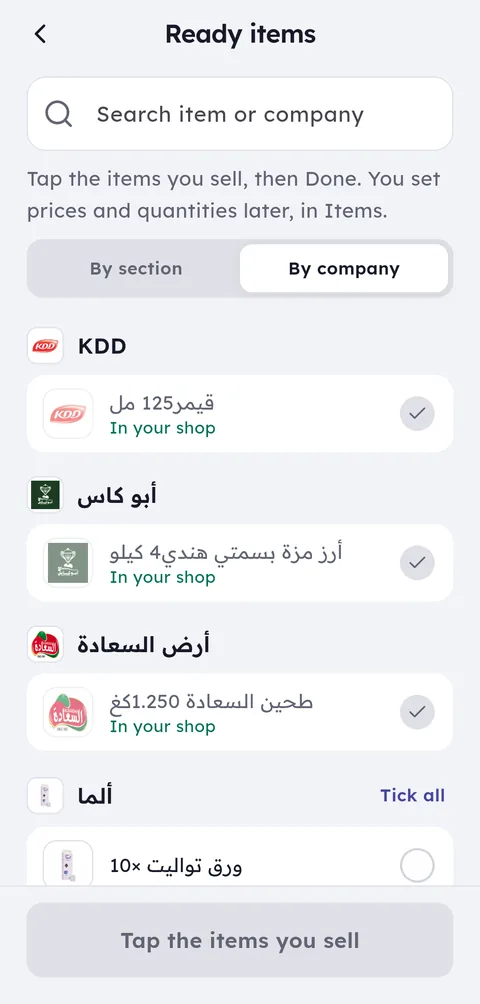
No file at all? You still don't start from a blank page. Ghalleh has a ready list of about 388 packaged items found in every grocery and mini market in Jordan: dairy and cheese, staples such as rice, oil and tea, tins, biscuits, crisps and cleaning products, each with its company's logo.
Tap the ones you sell and they join your items with no price. The first time one is scanned at the till, Ghalleh asks its price once and keeps it. You add the ready list when you create the shop, or later from the Items page.
- Start with the ready list, then import the rest from your supplier's file
- Anything not on it is added at its first sale by scanning its barcode
Weighed goods: cheese, olives and nuts by the kilo
White cheese, olives, nuts and vegetables don't sell by the piece. Create each one with kilo as its unit and a price per kilo. When staff weigh the amount on the shop scale, they enter the weight on the invoice and the amount is calculated.
For example, 0.750 kg of cheese at 6.000 JOD a kilo shows on the receipt as 4.500 JOD. Stock goes down by the same weight, so you know how many kilos are left in the fridge before you call the supplier.
If the counter scale prints a barcode label, the cashier scans it like any item and it goes in as weighed. And when a customer asks for a dinar's worth of nuts, the cashier types the amount and Ghalleh works out the weight from the kilo price.
Dairy and tins: expiry dates before the shelf loses money
Laban, fresh milk and packed cheese expire within days, tins and biscuits within months. Record expiry dates on the fast movers and check what's close to expiring every morning before the shop fills up. Two days left means the front of the fridge or a discount, not the bin at the end of the week.
With every delivery from the dairy company, enter the purchase invoice: quantity and cost update and the amount is added to that company's account. You know what you owe each sales rep before they walk in to collect.
Change a shelf price in a minute
When the supplier raises the price of oil or sugar, enter the purchase invoice and the item's cost updates. Then change the selling price and it reaches every till at once: the phone at the counter and the tablet at the other end. Nobody sells at the old price because they didn't hear about the change.
For many changes at once, like a whole brand's new price list, put each item's name, barcode and new price in an Excel file and import it, and the existing items' prices update in one go. Swap the shelf label the same day, so customers never see one price on the shelf and another on the receipt.
Handing over the shift
In a supermarket open from seven in the morning to midnight, the drawer changes hands more than once. Every shift starts with an opening float and ends when the cashier counts the cash and closes it. Ghalleh compares the count with what should be there after cash sales, and if there's a difference you're notified with the employee's name.
A morning shortage never mixes with an evening surplus, and you know which shift owns the gap. Staff clock in and out from their phone inside the shop, so you can see who was on the counter at any hour.
A mini market or a corner shop: the same till on one phone
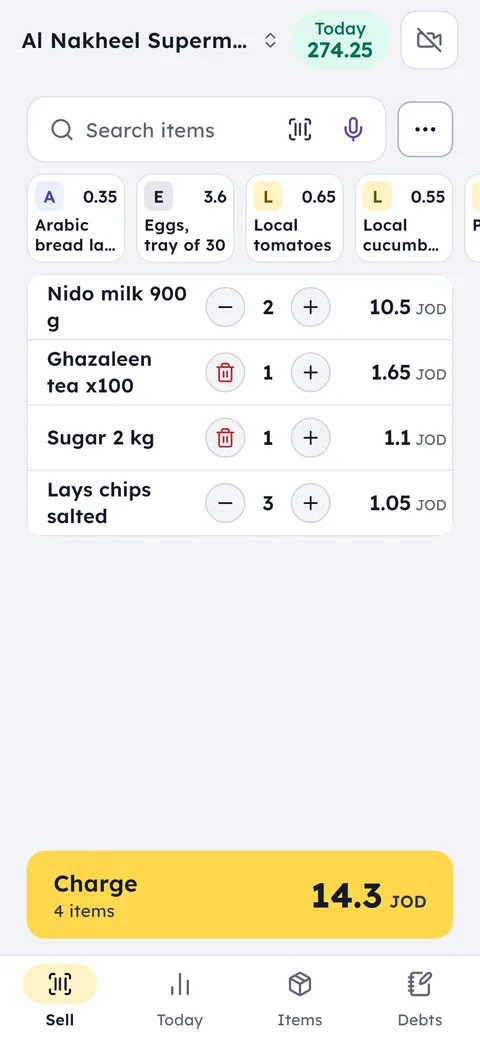
Not every supermarket has three counters. A mini market or a corner shop is often run by the owner alone, and the till is his own phone. Ghalleh runs on one phone and its camera, with a Bluetooth receipt printer if you want paper receipts, and the debt book in your pocket instead of hanging by the fridge.
As the shop grows, add a tablet or an Android POS terminal at the counter, or a Windows PC with a barcode scanner, all on the same shop, items and numbers.
How much does supermarket POS software cost?
Start is 5 JOD a month, 35 JOD a year, or 79 JOD once for three years: 2 selling devices, 1 branch, the owner and 3 staff. Pro is 12 JOD a month, 99 JOD a year, or 199 JOD for three years: 5 selling devices, 2 branches, the owner and 10 staff.
Every feature is in both plans, from the ready item list to JoFotara; they differ only in devices, branches and staff. You start with a 14-day free trial, no card. Prices are for the software only, no device included.
Accounting software for a supermarket? What Ghalleh works out for you
Plenty of grocery owners search for accounting software when what they need every day is simpler: what did I make, how much stock is on the shelves, what do I owe suppliers, and what do customers owe me. Ghalleh gives you all of those numbers with no bookkeeping entries.
Your annual tax return and the official books stay with your accountant. Give them Ghalleh's accountant file: a PDF with sales, tax and the JoFotara status of each invoice. Every invoice sent to JoFotara is on record there too, so they start from complete numbers instead of a handwritten notebook.
- Profit: sales minus the cost of what sold, for every day
- Stock value at cost
- What you owe each supplier after every purchase invoice
- The total of unpaid customer tabs