
Average basket calculator: average sale and items per sale
Enter a day's or a month's sales, the number of invoices and the items sold, and see what a customer spends per visit and how many items they buy, in JOD down to the fils.
Average basket
Formula: Average sale (ATV) = sales ÷ invoices · Items per sale (UPT) = items ÷ invoices · Average item price = sales ÷ items
How to use it
Total sales for the period in dinars, a day or a month, after discounts and returns.
Sales invoices in the same period, not counting return notes.
The total quantity sold across all invoices. All three results update as you type.
Average transaction value (ATV) is what a customer pays per invoice on average: sales divided by the number of invoices. Units per transaction (UPT) is how many items a customer buys per visit: items divided by invoices. Example: a supermarket took 1,248.750 JOD in a day across 185 invoices and sold 612 items. Its average sale is 6.750 JOD, it sells 3.31 items per sale, and the average item price is 2.040 JOD.
The two numbers answer different questions. The average sale rises when customers buy more items or pricier ones, and items per sale tells you which of the two happened. If the average sale goes up while items per sale stays flat, the cause is usually higher prices, not bigger baskets. Compare week against week rather than day against day: a Friday is nothing like a Tuesday, and the start of the month is nothing like the end.
A small shop can raise both in simple ways: put items that are bought together next to each other, like bread and dairy, offer a bigger pack at a lower unit price, keep small fast sellers by the till, and train the cashier to suggest one fitting item, not more. A second-item-half-price offer lifts items per sale, but check your margin first with the discount calculator, because a bigger basket is not always a bigger profit.
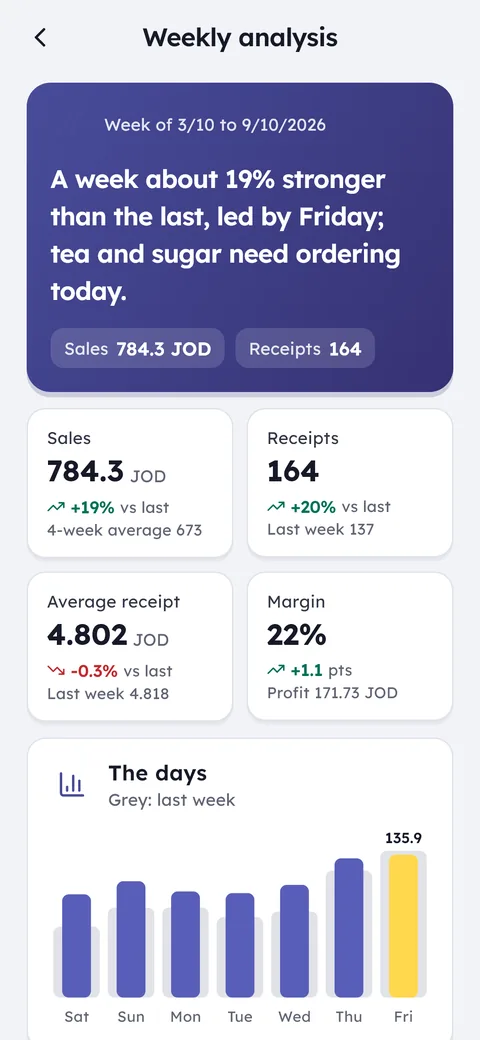
In Ghalleh the sales report shows your invoice count and average receipt, and the weekly report compares your sales with last week, so there is nothing to count by hand.
Common questions
What is the difference between ATV and UPT?
ATV is in dinars: what a customer pays per visit. UPT is in items: how many things they take per visit. UPT multiplied by the average item price equals ATV, so when one of them moves you can see where the change came from.
Should I use sales before or after tax?
Pick one and stick to it so your comparisons hold. The simplest is sales as the customer paid them, tax included, because that is what you see on the receipt. If you want to match your accountant's reports, use sales before tax.
What should my average sale be?
There is no number that fits every shop. People walk into a corner grocery for one or two things and leave a supermarket with a full basket. The useful number is your own: work it out every week and watch whether it moves after you change a shelf layout or run an offer.
How do I know how many items I sold?
From the sales report in your POS app: the total quantity on the period's invoices. Count anything sold by weight as one item per invoice, or the number climbs without meaning anything.
Open your shop on Ghalleh today.
Download the app, set up your shop yourself and try every feature free for 14 days, with no card.